January 25, 2026 (English, Spanish, and Vietnamese)
Dear MHT Parish and School Community:
Proposed Vision for the Pastoral Plan at MHT
After learning more about the parish community and pondering the Pastoral Plan of our Diocese, I am writing to share the fruit of my prayerful reflection and to ask for your feedback.
When I received the letter of appointment from Bishop Oscar Cantú, one of the things that grabbed my attention was the Bishop’s directive to implement the Pastoral Plan of the Diocese. This plan is the fruit of the 2021–2024 Synod. The Pastoral Plan is a long-range plan that will come to its climax in 2031, to coincide with the 50th Jubilee of our Diocese and the 500th anniversary of the apparition of Our Lady of Guadalupe. You can find the details of the plan on the Diocese’s website by opening this link: https://www.dsj.org/about-us/pastoral-planning/
The Bishop’s directive to implement the plan intrigued me because I was new to the Diocese and to Most Holy Trinity Church; thus, I did not know where to start. However, after six months of getting to know the parish—by observing, listening, and accompanying the community—I have been able to think about the plan with more clarity. I am grateful for this short time of getting to know the parish because we now need to take concrete action steps toward the implementation of the plan at MHT.
The Pastoral Plan has six strategic priorities/objectives, and an overview of these priorities is provided below.
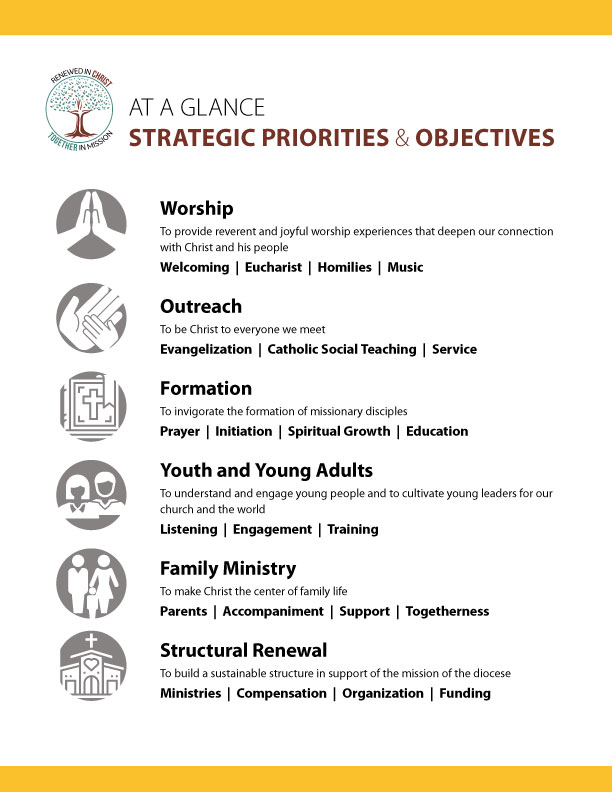
Bishop Cantú has asked each parish to roll out the plan by selecting the most important priority for the parish. Some parishes have selected their priorities, but we have not yet done so. Nevertheless, we need to roll out the plan by choosing a priority before the summer of 2026. In the meantime, we need to prioritize the plan by choosing one or two of the six priorities that would be most important for MHT at this moment. After getting to know the community during this brief period of time, and after listening to the staff and members of the Parish Council, I would like to share what I perceive at this moment to be most important for MHT to prioritize in relation to the priorities of the Pastoral Plan.
I believe that Formation and Youth and Young Adults are areas of primary importance for our parish community.
I see these two as primary areas for the investment of our energy and resources in the upcoming years, starting in the Fall.
The Pastoral Plan includes a $62 million financial campaign to support these priorities. Each parish will participate in the fundraising campaign, and a percentage of the funds raised by Most Holy Trinity will be reinvested into the implementation of the Pastoral Plan at MHT. In the next several months, more information will be provided regarding this campaign.
Formation is already happening in our parish community. We already have a large pool of participants in our current formation programs, including small faith-sharing and prayer communities, and the Ignatian Spirituality Center. I also see formation taking place through the valuable ministry of Most Holy Trinity School. Educating and forming children, youth, and adults must be a priority. Within the objectives of Formation, I see significant potential for enrichment and growth for every ethnic community and age group. Thus, we need to strengthen our formation programs and offer more programs and opportunities to continue fostering communities of disciples for all ages and groups.
I believe that investing more in Formation can enrich the Church and the parish community by providing opportunities for growth and participation in parish life. Formation programs can become a source for the various ministries of the Church and parish community. I see lay ministers being formed and emerging from this pool. I also see lay and religious vocations being shaped and strengthened across the age spectrum. Formation programs can also reach families, especially those seeking the Sacraments for their children. Formation programs foster small faith communities, which are vital for the life of the Church. Small faith communities help build up the Church. Without strong formation programs, the church community risks diminishing, because formation programs for all age groups are essential for the transmission of the Faith and Tradition. More than ever, I see Formation for all age groups as an urgent priority.
I see Youth and Young Adults in a similar vein and as a primary area of focus. We cannot ignore our youth, because we know too well that they are the present and the future of the Church, and that in this day and age, they are a group that cannot be left behind. Youth and young adults have expressed feelings of being left out, unwelcome, or disconnected from the life of the Church. We cannot ignore this reality. We need to help this group grow as disciples so that they can reach out to other youth and young adults. Furthermore, we need to reach out to them because they form a rich pool of disciples, lay leaders, and vocations to the priesthood and religious life.
In his address to the major superiors of the Society of Jesus, Pope Leo XIV listed a number of preferences for the Jesuits. Here is what the Pope said regarding youth:
“Accompanying young people toward a hope-filled future is urgent. The youth of today are diverse: students, migrants, activists, entrepreneurs, religious, and those on the margins. Despite their variety, they share a thirst for authenticity and transformation. They are ‘on the move,’ searching for meaning and justice. The Church needs to find and speak their language—through actions and presence as well as words. As a result, it is important to form spaces where they can encounter Christ, discover their vocation, and work for the Kingdom” (Oct. 24, 2025).
We already have an existing group of youth and young adults in the parish community. I have participated in their meetings, and I am impressed by the way they share their faith and doubts, by their discipleship, and by their desire to form a purposeful and meaningful community of belonging. I am also impressed by the strength and leadership of the youth and young adults in the Vietnamese Eucharistic Youth Movement, and by the vitality and potential of the parish’s Youth Leadership Programs. While we do have some opportunities for youth and young adults, there is much room for improvement and growth so that we can better serve this vital group. We need to attend to their needs so that they may spread the Gospel, inspire other youth and young adults to become disciples.
Furthermore, I see Formation and Youth and Young Adults as primary areas of focus because maintaining the status quo is not enough. We must invest in the future of the Church. Without making Formation and Youth and Young Adults priorities for everyone and across all age groups, we risk fewer people participating in Mass and fewer people supporting the ministries of the Church. I have chosen these priorities because I see the urgency of investing in these areas for the present and future of the Church. Prioritizing them does not exclude other priorities.
Now, let me share what I see as important but not a primary priority for our parish at this moment.
Worship/Liturgy will always be a priority because it is the source and summit of our Christian life. However, at this time, I do not see it as an area that needs to be prioritized within the context of the Pastoral Plan, because in recent years there has already been significant investment in this area—such as the renovation of the worship space, ongoing improvements to the sound system, and the renovation of the vestibule. Worship will continue to be a priority, and additional improvements will still be needed. Those involved in worship ministry—priests, liturgical ministers, and the assembly—can continue to invest greater engagement to enhance the worship experience. While improvements remain important, I do not see Liturgy as a primary investment focus within the Pastoral Plan at this time. That said, Worship will always remain central to parish life.
Outreach is important, but not a priority at this point. Evangelization is essential; therefore, we must first reach those already coming to MHT, many of whom are not yet fully engaged. This is why I am proposing Formation, and Youth and Young Adults as primary areas of focus. Catholic Social Teaching (CST) is a vital pillar of the universal Church. Pope Leo’s Apostolic Exhortation Dilexit Nos on love for the poor is one recent example. Social justice has long been central to the charism of the Society of Jesus. Thus, we should continue raising awareness and integrating CST values into homilies, formation programs, and prayer when appropriate. Service should continue to be fostered through existing parish ministries. We are blessed to have St. Vincent de Paul, which provides a concrete opportunity for service, and we should continue encouraging support for this ministry.
Family life is important because it is the domestic church; however, at this point, I do not see it as a primary priority. I do hope, though, that families will be reached through formation, youth, and young adult programs.
Structural Renewal is of primary importance for the Diocese and, therefore, for MHT as well. This will continue to be an ongoing conversation between the Diocese and the parishes.
All six priorities of the Pastoral Plan are important, but we cannot address all of them at once. I am presenting Formation and Youth and Young Adults as primary areas of focus for the coming years. I ask you to consider this proposal prayerfully, with the common good of the parish community in mind rather than personal preferences. Please also reflect on the future of our parish and the Church. This proposal is not a final decision, but a tentative direction offered for discernment. I invite your feedback. If you agree, please let me know. If you disagree, please share why. If you believe another priority should take precedence, I welcome your perspective and reasoning.
Most Holy Trinity is home to at least four language communities: English, Vietnamese, Spanish, and Tagalog. I am convinced that we need one another, because MHT is strongest when we live as one united and diverse community. Pope Leo XIV has been a strong advocate of synodality. In his address to the major superiors of the Society of Jesus, he stated:
“The synodal journey calls all of us to listen more deeply to the Holy Spirit and to one another, so that our structures and ministries may be more agile, more transparent, and more responsive to the Gospel.”
His predecessor, Pope Francis, spent his papacy fostering a vision of encounter for the Church, as he wrote in Fratelli Tutti:
“The word ‘culture’ points to something deeply embedded within a people, its most cherished convictions and its way of life. A people’s ‘culture’ is more than an abstract idea. It has to do with their desires, their interests and ultimately the way they live their lives. To speak of a ‘culture of encounter’ means that we, as a people, should be passionate about meeting others, seeking points of contact, building bridges, planning a project that includes everyone. This becomes an aspiration and a style of life. The subject of this culture is the people, not simply one part of society that would pacify the rest with the help of professional and media resources” (no. 216).
I recognize how difficult and imperfect the work of synodality can be. I also know how important it is for MHT to be a place of encounter with Christ and with one another as members of His Body. Let us strive to create a welcoming and inclusive culture at MHT and recommit ourselves to building strong community. Let us journey together into the future with a unified vision. Though MHT is diverse, we are united by the Holy Spirit, who binds us together in love and purpose.
Thank you for your prayerful consideration.
Fr. Elias Puentes, S.J.
Ngày 25 tháng 1, 2026
Giáo xứ và Trường Học Chúa Ba Ngôi Quý Mến:
Đề xuất Tầm nhìn cho Kế hoạch Mục vụ tại Chúa Ba Ngôi
Sau khi tìm hiểu thêm về cộng đồng giáo xứ và suy ngẫm về Kế hoạch Mục vụ của Giáo phận chúng ta, tôi viết thư này để chia sẻ những kết quả từ sự suy tư cầu nguyện của mình và mong nhận được ý kiến từ quý ông bà anh chị em.
Khi nhận được thư bổ nhiệm từ Giám mục Oscar Cantú, một trong những điều thu hút sự chú ý của tôi là chỉ đạo của Ngài về việc thực hiện Kế hoạch Mục vụ của Giáo phận. Kế hoạch này là kết quả của Thượng Hội đồng 2021–2024. Kế hoạch Mục vụ là một kế hoạch dài hạn và sẽ đạt đỉnh điểm vào năm 2031, trùng với kỷ niệm 50 năm thành lập Giáo phận chúng ta và kỷ niệm 500 năm Đức Mẹ Guadalupe hiện ra. Quý ông bà anh chị em có thể xem chi tiết về kế hoạch này trên trang mạng của Giáo phận: https://www.dsj.org/about-us/pastoral-planning/
Chỉ thị của Giám mục về việc thực hiện kế hoạch thu hút sự chú ý của tôi vì tôi là người mới ở Giáo phận và tại Nhà thờ Chúa Ba Ngôi (CBN); do đó, tôi không biết nên bắt đầu từ đâu. Tuy nhiên, sau sáu tháng tìm hiểu giáo xứ—bằng cách quan sát, lắng nghe và đồng hành cùng cộng đồng—tôi đã có thể suy nghĩ về kế hoạch một cách rõ ràng hơn. Tôi biết ơn về khoảng thời gian ngắn này để làm quen với giáo xứ, vì bây giờ chúng ta cần thực hiện những bước hành động cụ thể, để tiến đến việc thực hiện Kế hoạch Mục vụ tại CBN.
Kế hoạch Mục vụ có sáu ưu tiên/ mục tiêu, và sau đây là phần trình bày tổng quát về sáu ưu tiên đó.
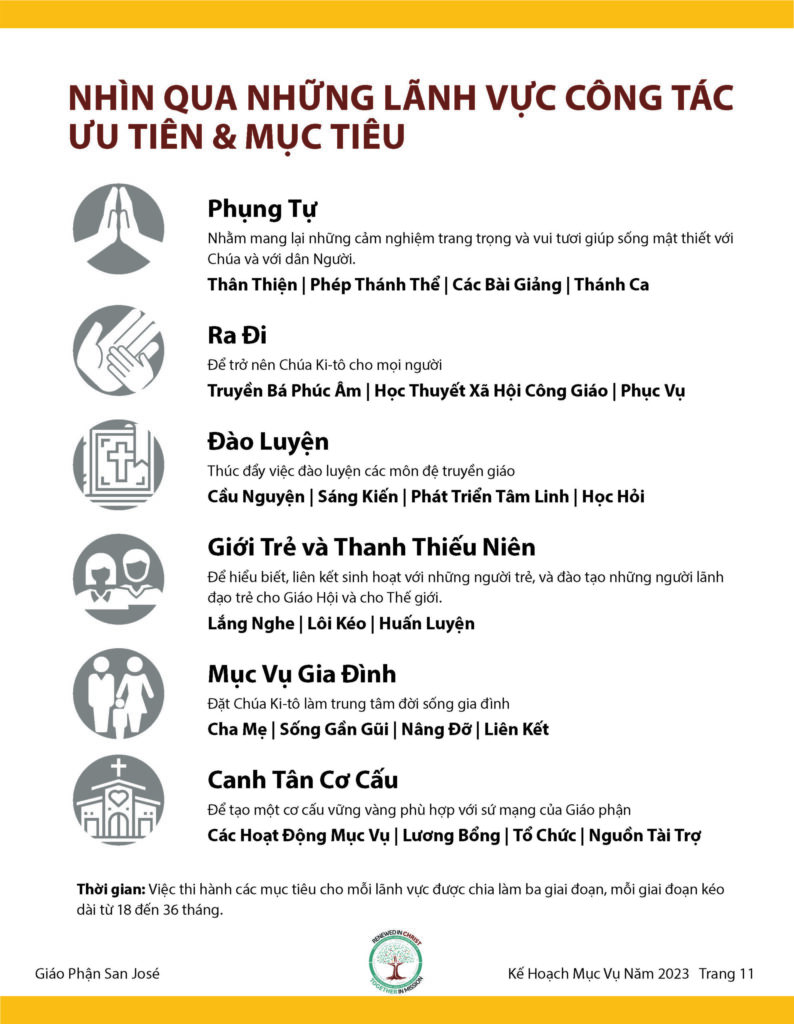
Giám mục Cantú đã xin mỗi giáo xứ triển khai kế hoạch bằng cách chọn ưu tiên quan trọng nhất cho giáo xứ mình. Một số giáo xứ đã chọn được ưu tiên của họ, nhưng chúng ta vẫn chưa làm. Tuy nhiên, chúng ta cần triển khai kế hoạch bằng cách chọn một ưu tiên trước mùa hè năm 2026. Trong thời gian hiện tại này, chúng ta cần chọn một hoặc hai ưu tiên quan trọng nhất đối với CBN. Sau khi tìm hiểu về cộng đồng trong khoảng thời gian ngắn vừa qua, và sau khi lắng nghe ý kiến từ nhân viên và các thành viên trong Hội đồng Giáo xứ, tôi muốn chia sẻ những gì tôi nhận thấy vào lúc này là quan trọng nhất để CBN chọn trong sáu ưu tiên trong Kế hoạch Mục vụ.
Tôi tin rằng Đào Luyện (Formation)và Thanh Thiếu niên và Giới trẻ (Youth and Young Adults)là những lĩnh vực quan trọng hàng đầu đối với cộng đồng giáo xứ của chúng ta.
Tôi nhận thấy hai lĩnh vực này là những phần chính cần đầu tư năng lượng và nguồn lực trong những năm tới, bắt đầu từ mùa Thu năm nay.
Kế hoạch Mục vụ của Giáo phận bao gồm một chiến dịch gây quỹ tài chính trị giá $62 triệu nhằm hỗ trợ những ưu tiên này. Mỗi giáo xứ sẽ tham gia vào chiến dịch gây quỹ, và một phần trong tổng số quyên góp được từ Giáo xứ CBN sẽ được đầu tư vào việc triển khai Kế hoạch Mục vụ tại CBN. Trong vài tháng tới, sẽ có thêm thông tin về chiến dịch gây quỹ này.
Giáo xứ chúng ta đã có chương trình Đào luyện, và nhiều người đang tham gia trong các chương trình Đào luyện, bao gồm các chương trình giáo lý, các nhóm chia sẻ đức tin, nhóm cầu nguyện nhỏ, cũng như Trung tâm Linh Thao I-nhã. Tôi cũng thấy việc đào luyện trong trường học CBN. Việc hướng dẫn và đào luyện cho trẻ em, thanh thiếu niên và người lớn phải là một ưu tiên. Trong chương trìnhĐào Luyện tôi thấy ở đó một tiềm năng đáng kể để làm phong phú và phát triển đời sống tâm linh cho mọi sắc tộc và mọi nhóm tuổi. Vì vậy, chúng ta cần củng cố các chương trình Đào Luyện hiện có của mình, và cung cấp nhiều chương trình và cơ hội hơn, để tiếp tục nuôi dưỡng đời sống tâm linh của các cộng đoàn môn đệ thuộc mọi lứa tuổi và mọi đối tượng.
Tôi tin rằng việc đầu tư nhiều hơn vào các chương trình Đào Luyện có thể làm phong phú Giáo hội và cộng đồng giáo xứ, bằng cách cung cấp cơ hội để mọi người phát triển và tham gia vào đời sống giáo xứ. Các chương trình Đào Luyện có thể trở thành nguồn lực cho các mục vụ khác nhau của Giáo hội và cộng đồng giáo xứ. Tôi nhận thấy các giáo dân trong vai trò thừa tác viên sẽ được đào tạo và xuất hiện từ nguồn này. Và từ nguồn này, tôi cũng thấy các ơn gọi giáo dân và tu sĩ được hình thành và củng cố ở mọi lứa tuổi. Các chương trình Đào Luyện cũng có thể tiếp cận các gia đình, đặc biệt là những gia đình đang cần cho con cái họ lãnh nhận các Bí Tích. Các chương trình Đào Luyện nuôi dưỡng những cộng đồng đức tin nhỏ, vốn quan trọng cho đời sống Giáo hội. Những cộng đồng đức tin nhỏ giúp xây dựng Giáo hội. Nếu không có các chương trình Đào Luyện mạnh mẽ, cộng đồng giáo hội sẽ lâm vào tình trạng suy giảm, vì các chương trình Đào Luyện cho mọi lứa tuổi là thiết yếu để truyền đạt Đức tin và Truyền thống. Hơn bao giờ hết, tôi thấy mục vụ Đào Luyện cho mọi lứa tuổi là một ưu tiên cấp bách.
Tương tự như vậy, tôi nhận thấy mục vụ Thanh Thiếu niên và Giới trẻ là một lĩnh vực trọng tâm chính. Chúng ta không thể bỏ qua giới trẻ, vì chúng ta biết rõ rằng họ là hiện tại và tương lai của Giáo hội, và trong thời đại ngày nay, họ là một nhóm không thể bị bỏ lại phía sau. Thanh thiếu niên và giới trẻ đã bày tỏ cảm giác bị bỏ rơi, không được chào đón hoặc bị tách rời khỏi đời sống Giáo hội. Chúng ta không thể phủ nhận thực tế này. Chúng ta cần giúp nhóm người trẻ này trưởng thành như những môn đệ, để họ có thể vươn tới các thanh thiếu niên và giới trẻ khác. Hơn nữa, chúng ta cần tiếp cận họ, vì họ tạo thành một nguồn phong phú đào tạo môn đệ, lãnh đạo giáo dân, và ơn gọi linh mục và đời sống thánh hiến.
Trong bài phát biểu trước các bề trên cấp cao của Dòng Tên, Đức Giáo hoàng Leo XIV đã liệt kê cho các linh mục Dòng Tên một danh sách những điều cần được ưu tiên. Đây là những gì Đức Giáo hoàng nói về thanh thiếu niên:
“Đồng hành cùng giới trẻ hướng tới một tương lai tràn đầy hy vọng là việc cấp bách. Giới trẻ ngày nay rất đa dạng: sinh viên, người di cư, nhà hoạt động, doanh nhân, tu sĩ và những người ở lề xã hội. Dù có sự khác nhau, họ đều khao khát sự chân thực và sự biến đổi. Họ luôn đang ‘di chuyển,’ tìm kiếm ý nghĩa và công lý. Giáo hội cần tìm ra ngôn ngữ của họ và nói bằng ngôn ngữ của họ — thông qua hành động và sự hiện diện cũng như lời nói. Do đó, việc tạo ra những không gian để họ gặp gỡ Chúa Kitô, khám phá ơn gọi của mình và làm việc cho Nước Trời là điều quan trọng” (24/10/2025).
Chúng ta hiện có nhóm thanh thiếu niên và giới trẻ trong cộng đồng giáo xứ. Tôi đã tham gia các buổi họp của họ, và tôi cảm thấy ấn tượng với cách họ chia sẻ đức tin và những nghi vấn của họ, với sự nhiệt thành trong việc làm môn đệ, và với mong muốn tạo dựng một cộng đồng gắn kết, có một mục đích và ý nghĩa. Tôi cũng cảm thấy ấn tượng với sức mạnh và khả năng lãnh đạo của thanh thiếu niên và giới trẻ trong Phong trào Thiếu Nhi Thánh Thể Việt Nam, cũng như với sức sống và tiềm năng của các Chương Trình Lãnh Đạo của Thanh Thiếu Niên trong giáo xứ. Dù chúng ta đã có một số cơ hội dành cho thanh thiếu niên và giới trẻ, vẫn còn rất nhiều điều có thể cải thiện và phát triển tốt hơn nữa dành cho nhóm quan trọng này. Chúng ta cần quan tâm đến nhu cầu của thanh thiếu niên và giới trẻ, để họ có thể truyền bá Tin Mừng, truyền cảm hứng cho các bạn trẻ khác trở thành các môn đệ.
Hơn nữa, tôi thấy mục vụ Đào luyện và mục vụ Thanh Thiếu niên và Giới trẻ là những lĩnh vực trọng tâm chính, vì nếu chúng ta chỉ duy trì những chương trình mục vụ trên như hiện tại là chưa đủ. Chúng ta phải đầu tư vào tương lai của Giáo hội. Nếu không đặt mục vụ Đào luyện vàmục vụ Thanh Thiếu niên và Giới trẻ làm ưu tiên cho tất cả mọi người và mọi độ tuổi, chúng ta sẽ lâm vào tình trạng là ít người tham dự Thánh Lễ hơn và ít người giúp đỡ ủng hộ các mục vụ của Giáo hội. Tôi đã chọn những ưu tiên này, vì tôi thấy tính cấp bách của việc đầu tư vào những lĩnh vực này cho hiện tại và tương lai của Giáo hội. Việc ưu tiên những chương trình mục vụ này không có nghĩa là chúng ta không quan tâm đến các ưu tiên còn lại trong sáu ưu tiên trong Kế Hoạch Mục vụ của Giáo phận.
Bây giờ, tôi xin chia sẻ những điều mà tôi cho là quan trọng nhưng không phải là ưu tiên hàng đầu đối với giáo xứ của chúng ta vào thời điểm này.
Phụng Tự (Worship) sẽ luôn là ưu tiên hàng đầu vì đó là nguồn mạch và đỉnh cao của đời sống Kitô giáo. Tuy nhiên, vào thời điểm này, tôi không cho rằng đây là lĩnh vực cần được ưu tiên trong Kế hoạch Mục vụ, bởi vì trong những năm gần đây đã có sự đầu tư đáng kể vào lĩnh vực này – chẳng hạn như việc làm mới không gian thờ phượng, cải thiện hệ thống âm thanh liên tục và sửa lại tiền sảnh nhà thờ. Phụng Tự sẽ tiếp tục là ưu tiên, và vẫn cần thêm những cải thiện khác. Những người tham gia vào mục vụ Phụng Tự – các linh mục, các thừa tác viên phụng vụ và cộng đoàn – có thể tiếp tục đầu tư nhiều hơn vào Phụng Tự. Mặc dù việc cải thiện vẫn rất quan trọng, nhưng tôi không xem Phụng Tự là trọng tâm đầu tư chính trong Kế hoạch Mục vụ vào thời điểm này. Tuy nhiên, Phụng Tự sẽ luôn là trung tâm của đời sống giáo xứ.
Ra Đi (Outreach)để tiếp cận cộng đồng là việc rất quan trọng, nhưng hiện tại chưa phải là ưu tiên hàng đầu. Truyền giáo là điều thiết yếu; do đó, trước hết chúng ta phải tiếp cận những người đã đến nhà thờ CBN, nhiều người trong số họ vẫn chưa thực sự tham gia tích cực. Đó là lý do tôi đề xuất Đào luyện và Thanh Thiếu niên và Giới trẻ như những lĩnh vực trọng tâm chính. Giáo huấn Xã hội Công giáo (CST) là một trụ cột quan trọng của Giáo hội hoàn vũ. Tông huấn Dilexit Nos của Đức Giáo hoàng Leo XIV về việc yêu thương người nghèo là một ví dụ. Công bằng xã hội từ lâu đã là trọng tâm trong đặc sủng của Dòng Tên. Vì vậy, chúng ta nên tiếp tục nâng cao nhận thức và đưa các giá trị của Giáo huấn Xã hội Công giáo vào các bài giảng, chương trình đào luyện và cầu nguyện khi thích hợp. Hoạt động phục vụ nên tiếp tục được thúc đẩy thông qua các hoạt động mục vụ hiện có của giáo xứ. Chúng ta may mắn có Hội Bác Ái Vincent de Paul đang phục vụ một cách cụ thể những người cần giúp đỡ, và chúng ta nên tiếp tục khuyến khích hỗ trợ chương trình mục vụ của hội này.
Mục Vụ Gia đình (Family Ministry) rất quan trọng vì gia đình là “giáo hội tại gia”; tuy nhiên, hiện tại, tôi không thấy đó là ưu tiên hàng đầu. Tuy nhiên, tôi hy vọng rằng các gia đình sẽ được lưu tâm đến thông qua mục vụ Đào luyện, mục vụ Thanh Thiếu Niên và Giới Trẻ.
Canh Tân Cơ cấu (Structural Renewal) là vô cùng quan trọng đối với Giáo phận và do đó cũng rất quan trọng đối với CBN. Đây sẽ là một cuộc đối thoại liên tục giữa Giáo phận và các giáo xứ.
Tất cả sáu ưu tiên của Kế hoạch Mục vụ đều quan trọng, nhưng chúng ta không thể thực hiện tất cả cùng một lúc. Tôi đề xuất hai lĩnh vực trọng tâm chính trong những năm tới là mục vụ Đào Luyện vàmục vụ Thanh Thiếu niên và Giới trẻ. Tôi xin mời quý ông bà anh chị em xem xét đề xuất này trong tinh thần cầu nguyện, với mục tiêu hướng đến lợi ích chung của cộng đồng giáo xứ thay vì sở thích cá nhân. Xin quý ông bà anh chị em cũng hãy cùng suy ngẫm về tương lai của giáo xứ và Giáo hội. Đề xuất này không phải là quyết định cuối cùng, mà là một hướng đi tạm thời được đưa ra để cùng nhau xem xét. Tôi rất mong nhận được ý kiến của quý ông bà anh chị em. Nếu quý ông bà anh chị em đồng ý, xin vui lòng cho tôi biết. Nếu quý ông bà anh chị em không đồng ý, xin vui lòng chia sẻ lý do. Nếu quý ông bà anh chị em cho rằng một vấn đề khác nên được ưu tiên hơn, tôi rất muốn được nghe quan điểm và lý lẽ của quý ông bà anh chị em.
Giáo xứ Chúa Ba Ngôi là nhà của ít nhất bốn cộng đồng ngôn ngữ: tiếng Anh, tiếng Việt, tiếng Tây Ban Nha và tiếng Tagalog. Tôi tin chắc rằng chúng ta cần nhau, bởi vì Giáo xứ Chúa Ba Ngôi mạnh mẽ nhất khi chúng ta sống như một cộng đồng hiệp nhất và đa dạng. Đưc Giáo hoàng Leo XIV là người ủng hộ mạnh mẽ tinh thần hiệp hành. Trong bài phát biểu trước các bề trên cấp cao của Dòng Tên, ngài đã tuyên bố:
“Hành trình hiệp hành mời gọi tất cả chúng ta lắng nghe tiếng nói của Chúa Thánh Thần một cách sâu sắc hơn, và lắng nghe lẫn nhau, để các cơ cấu tổ chức và những mục vụ của chúng ta trở nên linh hoạt hơn, minh bạch hơn và đáp ứng tốt hơn với Tin Mừng.”
Đức Giáo hoàng Phan-xi-cô, vị tiền nhiệm của Đức Leo XIV, đã dành cả triều đại giáo hoàng của mình để nuôi dưỡng tầm nhìn về sự gặp gỡ cho Giáo hội, như ngài đã viết trong thông điệp Fratelli Tutti:
“Từ ‘văn hóa’ chỉ ra điều gì đó ăn sâu vào bên trong một dân tộc, những niềm tin được trân trọng nhất và lối sống của họ. ‘Văn hóa’ của một dân tộc không chỉ là một ý niệm
trừu tượng. Nó liên quan đến những khát vọng, lợi ích và cuối cùng là cách họ sống cuộc sống của mình. Nói về ‘văn hóa gặp gỡ’ có nghĩa là chúng ta, với tư cách là một dân tộc, cần phải nhiệt huyết trong việc gặp gỡ người khác, tìm kiếm những điểm chung, xây dựng cầu nối, lập kế hoạch cho một dự án mà tất cả mọi người đều được bao gồm trong ấy. Điều này trở thành một khát vọng và một lối sống. Đối tượng của nền văn hóa này là toàn thể người dân, chứ không chỉ là một nhóm nào đó trong xã hội tìm cách xoa dịu phần còn lại của xã hội bằng sự trợ giúp của các nguồn lực chuyên nghiệp và truyền thông” (số 216).
Tôi nhận thấy công việc xây dựng tinh thần hiệp hành có thể khó khăn và không hoàn hảo. Tôi cũng biết tầm quan trọng của việc CBN trở thành nơi gặp gỡ Chúa Kitô và gặp gỡ nhau như những thành viên trong Thân Thể Chúa Kitô. Chúng ta hãy cùng nhau nỗ lực tạo ra một nền văn hóa chào đón và hòa nhập tại CBN, và lại cùng cam kết về việc xây dựng một cộng đồng vững mạnh. Chúng ta hãy cùng nhau tiến bước vào tương lai với một tầm nhìn thống nhất. Mặc dù CBN đa dạng, nhưng chúng ta được hợp nhất bởi Chúa Thánh Thần, Đấng nối kết chúng ta lại với nhau trong tình yêu và mục đích chung.
Chân thành cảm ơn quý ông bà anh chị em đã dành thời gian suy nghĩ và cầu nguyện về vấn đề này.
Cha Chánh xứ Elias Puentes, S.J.

18 y 25 de enero del 2026
Estimada Comunidad Parroquial y Escolar de MHT:
Propuesta de Visión Para el Plan Pastoral en MHT
Después de aprender más sobre la comunidad parroquial y de reflexionar sobre el Plan Pastoral de nuestra Diócesis, les escribo para compartirles el fruto de mi oración y reflexión y para consultar con ustedes.
Cuando recibí la carta de asignatura del Obispo Oscar Cantú, una de las cosas que me llamó la atención fue la directiva del Obispo pidiéndome que implementara el Plan Pastoral de la Diócesis. El plan es el fruto del Sínodo de los años 2021 – 2024. El Plan Pastoral es un plan de largo plazo que tendrá su clímax en el año 2031 para que coincida con el 50° Jubileo de nuestra Diócesis, y con el 500 aniversario de la aparición de Nuestra Señora de Guadalupe. Para ver los detalles del plan, abran la página web de la Diócesis: https://www.dsj.org/about-us/pastoral-planning/
La directiva del Obispo para la implementación del Plan Pastoral me intrigó porque yo estaba recién llegado a la Diócesis, y a la iglesia de La Santísima Trinidad. En ese tiempo no sabía por dónde empezar, pero después de seis meses de ver y escuchar, hoy día puedo pensar con más claridad. Estoy agradecido por este corto tiempo de conocer la comunidad de MHT y la Diócesis porque tenemos que tomar pasos decisivos para la implementación del plan en nuestra parroquia.
El Plan Pastoral tiene seis prioridades/objetivos estratégicos. Aquí pueden ver una descripción general.
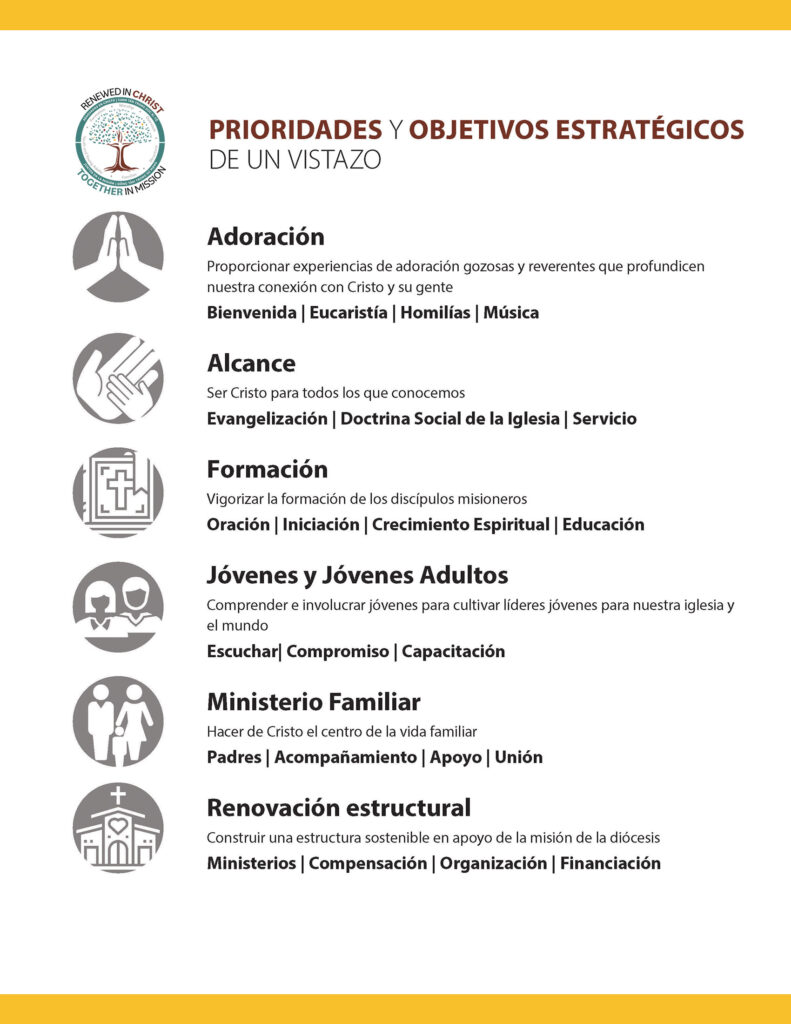
El Obispo Cantú le pidió a cada parroquia que iniciara la implementación del Plan seleccionando las prioridades más importantes para cada parroquia. Algunas parroquias ya han seleccionado sus prioridades, pero MHT aún no. Por lo tanto, antes del próximo verano, tenemos que escoger una o dos de las seis prioridades más importantes del Plan Pastoral para nuestra parroquia. Después de conocer la comunidad de MHT por un corto tiempo y de escuchar a los miembros del Concejo Pastoral y del personal de MHT, les comparto lo que percibo como prioridades más importantes para la parroquia en este momento.
Creo que Formación, Jóvenes y Jóvenes Adultos son de suma importancia para nuestra comunidad parroquial. Yo veo estas dos áreas como prioridad para invertir nuestras energías en los próximos años, iniciando en la primavera. El Plan Pastoral viene con una campaña financiera de $62 millones de dólares para apoyar las prioridades del Plan. Cada parroquia participará en la campaña de recaudación de fondos, y un porcentaje de los fondos recaudados se reinvertirá en la implementación del plan pastoral en MHT. En los próximos meses se proveerá más información sobre la campaña.
Formación ya existe en nuestra parroquia. Tenemos un grupo grande de personas bajo los programas de Formación, incluyendo a pequeños grupos de oración, junto con el Centro Ignaciano de Espiritualidad. También lo veo en el ministerio tan valioso que la Escuela Santísima Trinidad realiza. La educación y formación de niños, jóvenes y adultos tiene que ser una prioridad. En los objetivos de Formación veo más potencial para el enriquecimiento y crecimiento de todos los miembros de nuestra comunidad. Por lo tanto, veo la necesidad de fortalecer nuestros programas de formación y ofrecer más oportunidades para continuar fomentando comunidades para formar nuevos discípulos y fortalecer lo que ya existe. Poner mayor enfoque en las áreas de Formación puede enriquecer a la Iglesia y a nuestra parroquia, dando oportunidades para el desarrollo espiritual e intelectual y fomentar la participación en la vida de la parroquia. La formación puede ser una pileta de provisión para los diferentes ministerios de la Iglesia y de nuestra parroquia. Yo veo ministros laicos formándose y saliendo de programas de formación. También veo vocaciones religiosas y laicas formándose y fortaleciéndose en los programas. La formación también puede alcanzar a las familias, especialmente a aquellas que buscan Sacramentos para sus hijos. Programas de formación fomentan pequeñas comunidades de fe que son vitales para la vida de la Iglesia. Las pequeñas comunidades constituyen la Iglesia. Sin programas sólidos de Formación, la comunidad parroquial continuará disminuyendo porque los programas de formación para todas las edades son vitales para la transmisión de la Fe y Tradición. Más que nunca, veo la Formación para todos los grupos y edades como una prioridad urgente.
También veo Jóvenes y Jóvenes Adultos como prioridades de enfoque. No podemos ignorar a los jóvenes porque sabemos bien que ellos son el presente y el futuro de la Iglesia, y en la época en la vivimos, no podemos dejar en el olvido a este grupo. Muchos jóvenes y jóvenes adultos no se sienten acogidos por la Iglesia, incluso se sienten desconectados y alejados. No podemos ignorar esta realidad. Necesitamos a este grupo de jóvenes para que sean los nuevos discípulos que van a evangelizar a otros jóvenes y jóvenes adultos. Más aún, tenemos que alcanzarlos porque en este grupo de jóvenes hay una pila de discípulos, vocaciones laicas, religiosas y sacerdotales. En una audiencia con los superiores mayores de la Compañía de Jesús, el Papa León XIV enlistó un número de preferencias para los Jesuitas. Esto es lo que les dijo en relación con los jóvenes:
“Acompañar a los jóvenes hacia un futuro lleno de esperanza—es urgente. La juventud de hoy es diversa: estudiantes, migrantes, activistas, emprendedores, personas religiosas y aquellos que viven en los márgenes. A pesar de su diversidad, comparten una sed de autenticidad y transformación. Están en constante búsqueda de sentido y justicia. La Iglesia necesita comprender y hablar su lenguaje, a través de acciones, presencia y palabras. Por lo tanto, es importante crear espacios donde puedan encontrarse con Cristo, descubrir su vocación y trabajar por el Reino de Dios, 24 de oct. 2025.”
Tenemos grupos de jóvenes y jóvenes adultos en la parroquia. Yo he sido parte de sus reuniones y he quedado impresionado por la manera en que comparten su fe y sus dudas, por su discipulado y el deseo de formar una comunidad de pertenencia con intencionalidad, propósito y con un significado valioso. También estoy impresionado por la fortaleza y el liderazgo de los jóvenes y jóvenes adultos del Movimiento Eucarístico Vietnamés y por la vitalidad y potencial de los Programas de Liderazgo Juvenil de la parroquia. Mientras que ya tenemos programas para jóvenes y jóvenes adultos, aún hay más espacio de mejoría y crecimiento para poder servir mejor las necesidades de este grupo tan vital. Necesitamos atender a las necesidades de los jóvenes y jóvenes adultos para que ellos puedan inspirar a otros jóvenes para ser discípulos y evangelizadores.
Formación, Jóvenes y Jóvenes Adultos son áreas de prioridad y de enfoque porque mantener el estado actual de la iglesia no es suficiente. Tenemos que invertir en el futuro. Si no ponemos Formación para todos y todas las edades, y a jóvenes y jóvenes adultos como prioridad, corremos el riesgo de tener menos personas atendiendo Misa, y menos personas involucradas en los ministerios de la parroquia. He seleccionado estas como prioridad porque veo la urgencia de invertir en estas áreas para el bienestar del futuro y del presente de la iglesia. La priorización de estas áreas como enfoque en los próximos años no excluye a otras prioridades.
Ahora les comparto lo que veo como importante, pero no prioritario en este momento para nuestra parroquia.
Adoración/Misa siempre será una prioridad porque es la fuente de la vida cristiana. Dicho esto, en este momento, la Adoración/Misa no es algo urgente para priorizar. Más aún, en los últimos años se ha puesto énfasis en la Adoración/Misa. Un ejemplo está en la renovación del espacio sagrado (la iglesia), el esfuerzo que hay en mejorar el sistema de sonido y en la renovación en el área del vestíbulo. La Adoración/Misa continuará siendo una prioridad, por lo tanto, requiere hacer más mejoras. Los que nos involucramos en el ministerio de la Adoración, sacerdotes, todos los ministros de la Liturgia/Adoración y todos los demás feligreses podemos hacer un mayor compromiso para tener una mejor experiencia de la celebración. Mientras que hay mejoras por hacer, en este momento no veo la Adoración/Misa como un área urgente para priorizar. Dicho esto, Adoración/Misa siempre será área central de importancia.
Alcance es importante, pero no una prioridad en este momento. La evangelización es muy importante, por lo tanto, tenemos que empezar a evangelizar a los que ya están viniendo a la iglesia, pero que aún no están siendo alcanzados/evangelizados. Necesitamos crear espacio y oportunidades para ellos/as. Por eso creo que la formación para todas las edades es importante. La Enseñanza Social Católica (ESC) es un pilar importante de Iglesia universal. La Exhortación Apostólica DILEXI TE a todos los cristianos sobre el Amor a Los Pobres es uno de los ejemplos más recientes de la ESC. Más aún, la Enseñanza Social Católica está muy cerca del pensamiento de La Compañía de Jesús, por lo tanto, es importante para los Jesuitas. Entonces, tenemos que concientizar y acompañar a las personas e incorporar los valores de ESC en las homilías, programas de formación y la oración cuando sea apropiado. El servicio es importante, por lo tanto tenemos que fomentar un espíritu evangélico de servicio en nuestra parroquia para alimentar los diversos ministerios de la parroquia. Tenemos la fortuna de tener el centro de servicio social de San Vicente de Paul. Esta es una gran oportunidad de servicio. Sigámosle brindando nuestro compromiso.
Familia siempre es importante porque es la iglesia doméstica, pero en este momento no es una prioridad de enfoque para nuestra parroquia. El alcance a la familia puede ser por medio de formación, jóvenes y jóvenes adultos.
Renovación Estructural es de importancia primaria para la Diócesis. Por lo tanto, es importante para todas las parroquias dentro de la Diócesis, incluyendo la nuestra. El tema de la renovación estructural seguirá siendo tema de discusión entre Diócesis y parroquias.
Entiendo que las seis prioridades del Plan Pastoral son importantes, pero no podemos elegir todas a la misma vez. Estoy priorizando Formación, Jóvenes y Jóvenes Adultos como áreas de enfoque para los próximos años. Lo hago sin desatender las otras áreas. En espíritu de oración, les pido consideren Formación, Jóvenes y Jóvenes Adultos como prioridades de enfoque. Cuando lo hagan, consideren el bien común de la comunidad parroquial, y no solo en prioridades personales. Más aún, por favor, piensen en el futuro de la Iglesia y de nuestra comunidad parroquial. Lo que yo le presento es una propuesta de lo que yo veo como prioridad para la parroquia, pero no es una decisión final. Por lo tanto, les pido su consulta. Si están de acuerdo con la propuesta, díganmelo. Si están en desacuerdo, háganmelo saber, y díganme por qué. Si hay una prioridad más urgente de las que yo presento, díganme cuál es y por qué es más importante.
La parroquia de la Santísima Trinidad es hogar de por lo menos cuatro comunidades lingüísticas: inglés, vietnamita, español y tagalo. Estoy convencido de que cada una necesita a las demás, porque la Santísima Trinidad solo es fuerte cuando nos vemos como una comunidad unida y diversa. El Papa León XIV ha sido un firme defensor de la sinodalidad. Les comparto más de lo que les dijo a los superiores mayores de la Compañía de Jesús:
“El camino sinodal nos llama a todos a escuchar con mayor atención al Espíritu Santo y a los demás, para que nuestras estructuras y ministerios sean más ágiles, más transparentes y respondan mejor al Evangelio.”
Su predecesor, el Papa Francisco, dedicó su pontificado a fomentar una visión de encuentro para la Iglesia, como afirmó en una de sus encíclicas:
“La palabra ‘cultura’ indica algo que ha penetrado en el pueblo, en sus convicciones más entrañables y en su estilo de vida. Si hablamos de una ‘cultura’ en el pueblo, eso es más que una idea o una abstracción. Incluye las ganas, el entusiasmo y finalmente una forma de vivir que caracteriza a ese conjunto humano. Entonces, hablar de ‘cultura del encuentro’ significa que como pueblo nos apasiona intentar encontrarnos, buscar puntos de contacto, tender puentes, proyectar algo que incluya a todos. Esto se ha convertido en deseo y en estilo de vida. El sujeto de esta cultura es el pueblo, no un sector de la sociedad que busca pacificar al resto con recursos profesionales y mediáticos, Fratelli Tutti, #216.”
Comprendo lo difícil e imperfecto que puede ser el trabajo de la sinodalidad. También sé lo importante y necesario que es la sinodalidad en nuestra parroquia para ser verdaderamente un lugar de encuentro con Cristo y con los miembros de su Cuerpo: la comunidad parroquial. Por lo tanto, trabajemos para crear una cultura acogedora e inclusiva en MHT y comprometámonos a construir un fuerte sentido de comunidad. Caminemos juntos hacia el futuro con una visión unificada. Aunque MHT es diversa, estamos unidos por el Espíritu Santo, que nos une en el amor y en un propósito común.
Gracias por considerar la propuesta en su oración.
P. Elias Puentes, SJ